


Appliquer: Designing an Honest AI Decision Engine
Nov 2026
Role: Product manager and designer (solo) Timeline: 2026 – present Tools: Claude (Projects, MCP connectors, browser automation), LinkedIn, Trello Focus: Human-centered AI design, decision UX, AI governance
The problem
Job searching as a product manager is a prioritization problem disguised as a volume problem. Every posting looks plausible, every evaluation takes about 30 minutes to do well, and fatigue sets in fast. Before Appliquer, I could realistically evaluate about 10 roles a week before quality dropped.
Existing AI tools made this worse, not better. Most "job match" tools return a single score (looking at you, LinkedIn and others), which hides the reasoning, flatters the candidate, and can't tell you why a role is or isn't worth your time. A score of 78% doesn't tell you whether the gap is a dealbreaker or a resume edit.
I wanted a tool that would behave like a trusted PM mentor: tell me honestly whether a role deserves my limited time, show its evidence, and admit what it doesn't know.
My role
I owned the product end to end: defining the problem, writing the product principles, designing the reasoning framework and output experience, connecting the integrations, and validating the rubric against real job postings. Appliquer runs on Claude, so my design surface was the system's reasoning and its output, rather than a traditional screen-based UI.
Design principle: decision quality over volume
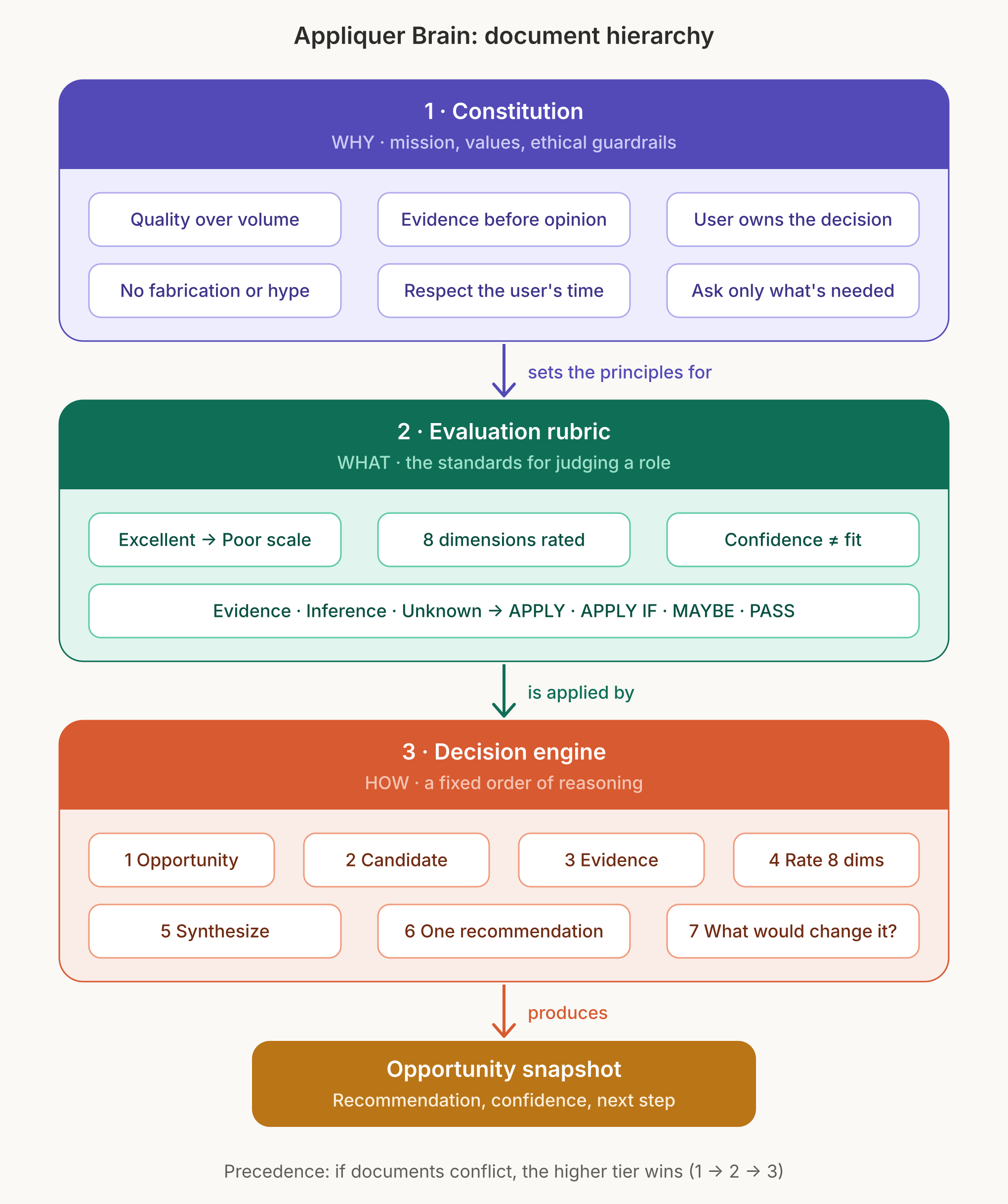
I started by writing a short Constitution, a set of principles the system must follow, before designing any features. Three of them shaped everything else:
Better decisions, not more applications. The system succeeds when I apply to fewer, better-fit roles, not more.
Evidence builds trust. Every claim must trace back to the resume or the job description.
Final decisions belong to the user. AI augments judgment; it doesn't replace it.
I also set an order of precedence (Constitution, then Evaluation Rubric, then Decision Engine) so that when rules conflict, the system resolves them predictably instead of improvising.
Designing the reasoning: Evidence, Inference, Assumption
The core design problem was that language models default to sounding confident and optimistic. For a career decision, that's the wrong behavior. An over-optimistic recommendation wastes hours on a long-shot application.
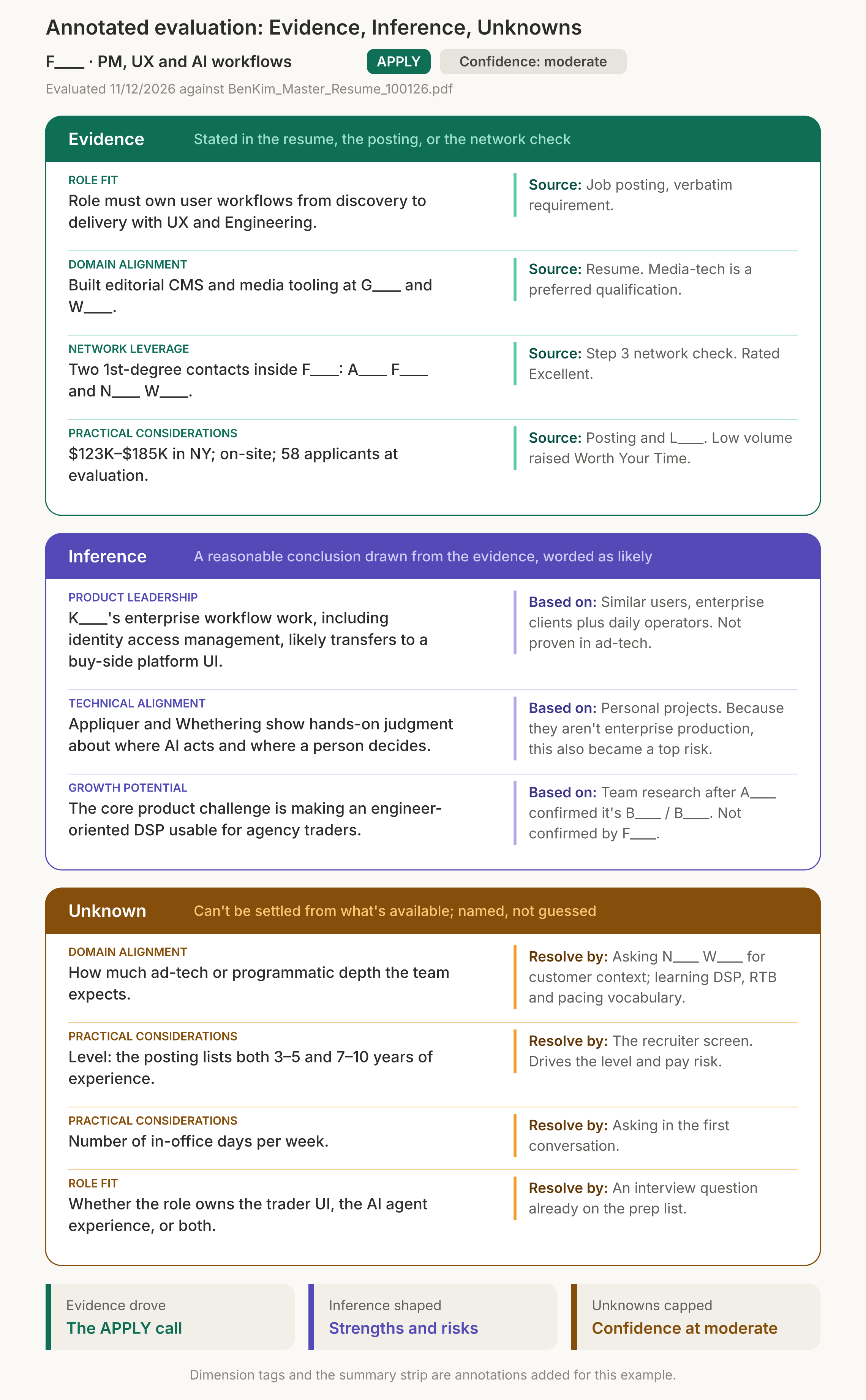
My solution was to require every evaluation to sort its findings into three categories:
Evidence: facts directly supported by the resume or posting ("led and mentored a team of PMs at Knotel").
Inference: reasonable conclusions drawn from evidence ("B2B2C experience likely transfers to learner and partner workflows").
Unknowns: things the system cannot verify ("the posting requires WCAG work; the resume doesn't mention it").
This single structural choice made the output auditable. I can disagree with an inference without distrusting the whole evaluation.
The Decision Engine then walks through a fixed sequence: understand the opportunity, understand the candidate, gather evidence, rate eight dimensions (Role Fit, Growth Potential, Technical Alignment, Product Leadership, Domain Alignment, Practical Considerations, Opportunity Cost, Network Leverage), synthesize without mechanically averaging, and return exactly one recommendation: APPLY, APPLY IF, MAYBE, or PASS. It ends with a reflection step: what evidence would change this recommendation?
APPLY IF was a deliberate addition. Many roles aren't a clear yes or no; they're a yes only if a specific condition holds (a portfolio exists, salary fits, a referral is available). Naming the condition turns a vague "maybe" into an action.
Designing the output: a 15-second snapshot
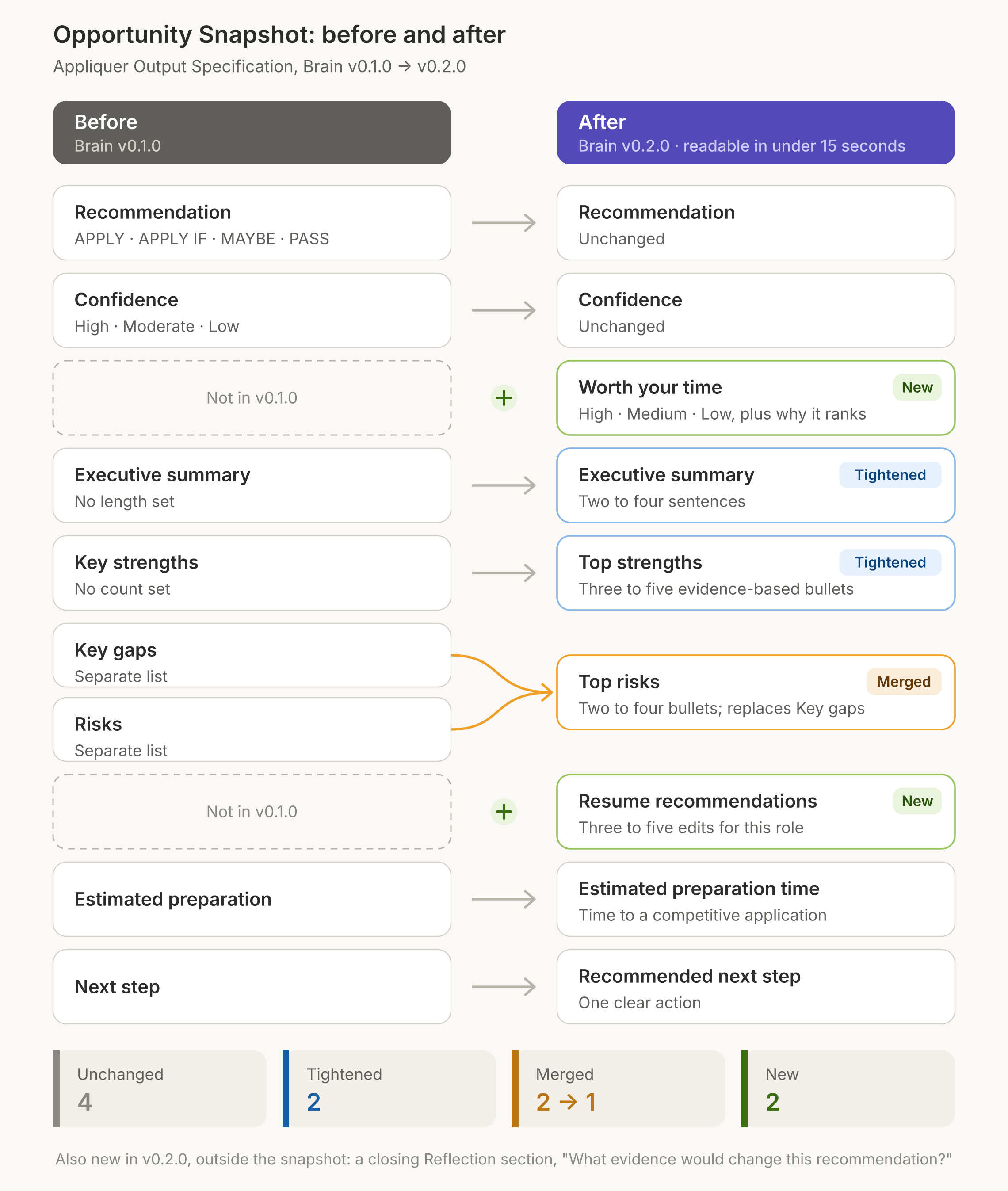
I designed the output around progressive disclosure. The top section, the Opportunity Snapshot, has to be understandable in under 15 seconds: recommendation, confidence, whether it's worth my time, a short summary, top strengths, top risks, and one next step. Detailed reasoning follows for when I want to dig in.
I iterated on this from real use. Version 0.2 of the output spec:
Replaced "Key Gaps" with "Top Risks", because a gap only matters if it threatens the outcome.
Added "Worth Your Time", a separate rating from fit, because a good-fit role can still be a poor use of time when warmer leads are in motion.
Capped the Executive Summary at four sentences, after early outputs ran long.
Added Resume Recommendations and a Reflection section, so every evaluation ends with something actionable.
I also separated Confidence from fit. Confidence measures how complete the information is, not how good the match is. A strong-looking role with a vague posting gets a high-fit, low-confidence rating, and that distinction changes what I do next.
Human-centered AI guardrails
Several rules exist specifically to keep the AI honest:
Absence of evidence is not evidence of absence. The Network Leverage check searches LinkedIn for 1st- and 2nd-degree connections at the company. If it finds none, or LinkedIn blocks the search, the output says "Unknown," never "no connections."
Provenance on every evaluation. Each output names the resume file it was evaluated against, so I can catch a stale version.
Ask only what matters. The system must use all available evidence before asking a question, and keep going when a useful recommendation is still possible.
No fabrication or inflation. It may not invent qualifications or exaggerate fit, and it flags resume claims that aren't accurate.
These rules are governance as much as UX: they define what the system is allowed to claim and how it handles uncertainty.
Integrations
I connected the tools myself so evaluations fit into my actual workflow:
LinkedIn (via browser automation) for the network check, run automatically during evidence gathering.
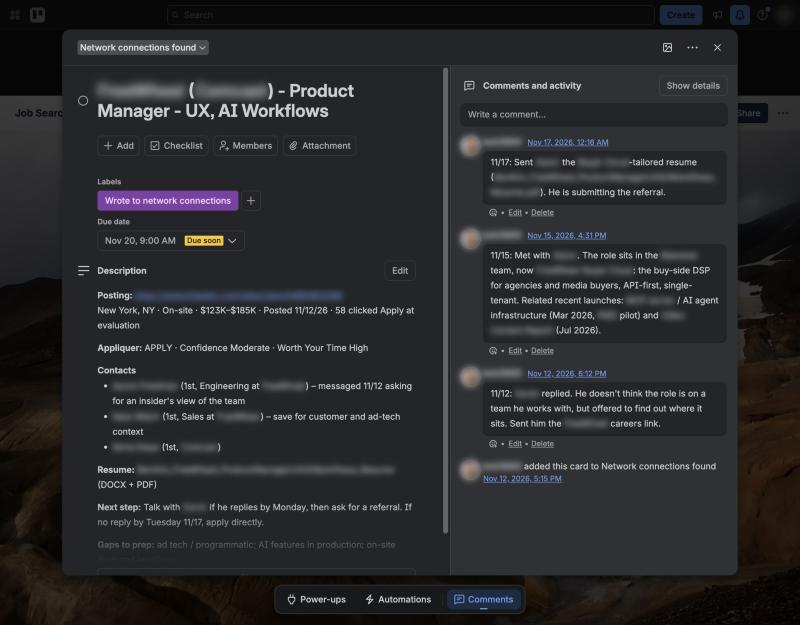
Trello for tracking: promising roles become cards with the posting, link, Appliquer output, and tailored resume attached.
Results
About 116 opportunities evaluated since September 2026.
About 15 minutes per evaluation, versus about 30 by hand, roughly 29 hours saved so far.
Better-targeted effort: the system regularly recommends MAYBE or PASS on roles that look good at first glance, and APPLY IF turns borderline roles into a specific to-do.
What I learned
For AI products, the reasoning is the interface. Most of my design work went into structure (categories, sequence, precedence) rather than visuals, and that structure is what users actually experience.
Honest beats impressive. Separating evidence from inference made the tool more trustworthy, even when the answer was less flattering.
Real use drives iteration. Every change in v0.2 came from reading outputs and noticing where they wasted my time.
The check isn’t perfect. On one evaluation, it found a single 1st-degree contact, at the parent company rather than the business that was hiring, and missed two direct contacts at the company itself. I added them, the Network Leverage rating rose to Excellent, and one of them ended up referring me. The rule I’d written covered finding no one; it didn’t cover finding too few. So I changed it: the check now searches the hiring company first, labels where each contact works, and treats every list as possibly incomplete.
What's next
Add a comparison mode for weighing two opportunities side by side.
Track outcomes (interviews, offers) against recommendations to measure whether the rubric predicts success.
Validate the rubric with other PMs, not just myself.